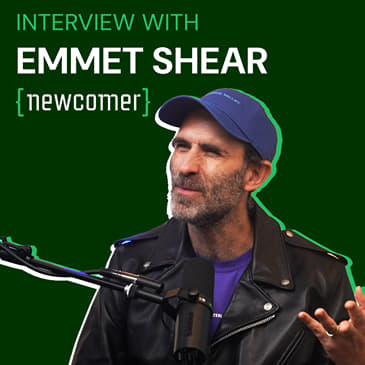
Former OpenAI interim CEO Emmett Shear explains why AI’s future is bigger than any one leader, including Jensen Huang.The Twitch co-founder and Softmax CEO reflects on his brief time at OpenAI, Silicon Valley’s fixation on founders, and why leadership changes can take years to reshape a company. He discusses NVIDIA, lessons from Steve Jobs and Tim Cook at Apple, and how social media pulls attention toward headlines instead of deeper breakthroughs.Shear also explains Softmax’s approach to AI alignment: starting with cooperation between individual humans and AI, then building toward larger groups. For him, the question goes beyond whether ChatGPT or Claude follows instructions to whether humans and AI actually share goals.
[00:00:00] You know that you cannot trust CEOs who wear leather jackets. Hmm. All right, we've got Emmett Shear here, CEO, co-founder of Softmax. Of course, before that, YC, Twitch, and then the very brief role that you played in the OpenAI Sam Altman blip saga. I mean, it's a crazy day to have an AI conference in the midst of, you know, what's going to end up being like a seismic moment in the AI industry.
[00:00:28] And you're someone who's lived in the middle of, like, a maelstrom of AI, you know, history. What's going through your mind right now as you kind of see things playing out, you know, with Jensen Huang stepping down and everyone kind of just in very react take mode? Well, I mean, it's just a starting point. You know that you cannot trust CEOs who wear leather jackets. They're just, like, they're just fundamentally, like, there's, I mean, there obviously can be high performers, but, like, you never know what they're going to do. Yeah. Word to the wise.
[00:00:57] But really, I think everyone always pays too much attention to the shiny object and not enough attention to the deeper forces driving things along. Like, no one is irreplaceable. And also, you know, of course, everyone, people do make a difference. So, I mean, things will change.
[00:01:24] But when I think about the things happening today that are, you know, seismic, it's what we're learning about how information topology works and how the platonic realm is real. I don't know if people notice that, but, like, there's incredible papers coming out. Michael Levin has a particularly good one about the platonic realm and platonic forms. But, like, that basically all transformers, all machine learning things learn the same.
[00:01:51] It's all different, but the topology of the information geometry, the topology of the structures inside them is the same. Even in the ones that are trained completely separately. Yeah. So, like, the structure of, like, how the days of the week relate to each other, how the months relate to each other is the same. That's weird. That's not what we expected to go find. And so, like, I'm really into that. I think that discovery is really important to change the course of the world.
[00:02:21] Right. And, you know, probably changing leadership in NVIDIA does, too, but, like, how do you know which scale to be paying attention to? Your point is basically, like, the science and the progress exists independent of an individual. Or maybe it's... These sort of breakthroughs will end up being far more significant than who is directing the capital, which is essentially the job of the CEO. It is almost certain at this point that what's more important than either of those things is, you know, some little startup just launched their thing today. Yeah.
[00:02:51] Somebody at one of the big labs just figured something out that, holy crap, guys, have you seen this? Yeah. Or something that's I didn't even like... Almost certainly something I didn't list, right? But something... We pay far too much attention to the one thing of the moment that, like, everyone is like... Like, we're just... Since the world has gotten so over-connected, right? Everybody's connected to everybody all the time. All connectivity. Yeah. And it's funny, actually. We don't soft max it. Yeah. We don't soft max attention. Soft max of attention.
[00:03:19] Over attention means you're forced to sort of, like, not pay medium levels of attention to things. You can only pay attention to the stuff that's really important. And then stuff in the middle gets pushed down. Yeah. And what that means is, like, you can pay attention to your family, to your friends, to your job. Right. But sort of middle attention stuff that, like, oh, everyone's talking about this. It's too... If you... Which we do in a transformer. If you apply a soft max over your attention distribution, you suppress all that stuff.
[00:03:49] You suppress this seemingly maybe important, but, like, not more important than the actual important things. Yeah. Yeah. And the problem is, if you don't do that, the transformer, all the little tokens trying to figure out what they should pay attention to. Yeah. They start getting... It's noise. Uh-huh. They can't hear the signal anymore because they're paying attention to all this noise. And so, but you're aligning that basically with the way humans are absorbing, you know, seismic news.
[00:04:17] Is that like, you're so focused on the one thing, you're sort of unable to, you know, disambiguate the noise with the actual... We're all transformers in a little recurrent transformer layer. Yeah. And I'm a token and you're a token. Yeah. And we're attending... We're attending to... We both have a query where we're looking out and we're attending to some set of the other humans. Right. And we're also producing... Right. Our value is down those channels and like, it's just like a recurrent transformer.
[00:04:47] Yeah. Metaphor. This is a metaphor, right? Right. And kind of not, but mostly a metaphor. But like, I think it's a productive one because what it used to be that we weren't all connected, that people in France connected to people in France and people in America connected to people in America. Yeah. And even before that, it was people in Texas and people in New York and you had local newspapers. Yeah. We haven't had non-global attention for a while. Yeah. We're all in this big, all connected thing. But as someone who's lived through essentially this, right? Right.
[00:05:14] Like you were kind of a part of a piece of this sort of media craziness that ends up, you know, not me mattering that much in the matters for you, obviously. Yeah. And you start your own company. We talked about that. But like, what do you... From having lived through this, like what can we take from this particular moment that you think helps put it in context and makes it seem more rational and not catastrophic or seismic? The situation is normal. It's all fucked up. Yeah. Like that's, there's a word for it. It's a snafu.
[00:05:42] It's like, this is the way the world is all the time. There's never, you're never in a time like this. Like in the OpenAI thing, like it was really important to me. And I think it was really important to probably to Sam and the people on the board and people who are at OpenAI. It was very impactful on their lives. And like, you have Mira and Ilya going and starting their own companies. And like, this is a... Everything kind of fell apart and was like reconstructed over the course of a couple of days.
[00:06:12] And like, well, no, but it wasn't because then you have thinking machines and you have super intelligence. And I go and start Softmax. And now, and now Sam's back, but he's back with a new board. Yeah. Like a bunch of shit happened. A bunch of things. But for like, for me, for the people who are involved and I'm sure thing, I bet Jensen will have a different life now. I bet, I bet the people close to Jensen will have a different life. I bet, I bet NVIDIA will have people who... But if you don't, if you're not directly involved, it's noise. Yeah.
[00:06:41] That's what it's not important. But like, what different decision can you possibly make as a result? Really nothing because you have no idea. It doesn't really impact you. It's not actually about you. Right. It feels like it is, but it's not. Do you think it's not really... I mean, you're someone in, you know, in the industry, you've raised money. NVIDIA is obviously hugely influential in the directing of chips. And obviously capital for backing a lot of these things. Do you think people are overestimating the significance of one person towards just the continuance of funding and the way that money goes to startups? I mean, so Steve Jobs, titan.
[00:07:12] Titan of innovation, of industry. Like, you know, one of, I think every entrepreneur's role model is in a certain way. Everyone wants to be Steve Jobs. I think everyone can be. I think I'm not sure. I don't lead much like Steve Jobs does, but I would like to. He's so cool, right? Yeah. And he steps down. And Tim Cook. Tim Cook is, I'm not, no, a spurt to me. Tim Cook is no Steve Jobs. Yeah. You'd be the first to say it. And how's your iPhone? Still around. And like, I don't know. Like, I haven't found it. Changes.
[00:07:43] I'm sure over a 10-year period, whether Steve Jobs is leading Apple or Tim Cook is, I bet the company's now in a very different place. Sure. For the next three years. Uh-huh. These things are locked in. Everything's locked in. It's all on rails. You don't, as a CEO, if you're, unless you were incompetent, you are not steering the company today. You're steering the company years out. Right. You're laying groundwork. And so, yeah, it probably does mean something. What does it mean? We don't know, and it will take years to find out.
[00:08:12] And why are you thinking about this? There's so much going on. There's so many things you could be thinking about. You're thinking about this because, because the system doesn't have any breaks. Right. Because there's, it has positive, because it looks like there's three buttons on a, on a Twitter post, right? It looks like it's three. There's a like, there's a retweet, and there's a comment. And you think that the retweet is a dunk, and the comment is negative, and the like is positive. Yeah. They're all, yeah, more of this, please, more of this, please, more of this, please. Yeah.
[00:08:41] And there is no inhibitory button. Well, there is actually, if you double the triple dots and then don't like mute, block, less like this. Very few people do that. No, because it doesn't, because the system isn't set. There's a reason why it's behind the triple dots. Yeah. I think we should put a next to the like button. I think we should have a clown button. Uh-huh. What would that do? What would that mean? It's anti-like. It says less like this, but this is like, this is a clownish thing to show me. Yeah. Less like this, please. Right. Don't, not this. Well, people very rarely take the algorithm, you know, like they kind of let it wash over them.
[00:09:11] They're very rarely directing, you know, I don't like this content. It's not relevant. Things like that. I mean, I feel like people are so accustomed to it. They're directing it all the time exquisitely with their attention. Yeah. I mean, you know, one of the things that's always fascinating to me as a reporter in Silicon Valley is like, you know, the obsession with the founder and the belief that the founder is like the singularly most determinative aspect of the success of a startup. And like, you know, we have an interesting dichotomy here potentially with NVIDIA and OpenAI where, you know, Sam leaves.
[00:09:38] We never really get to experience what the company is going to be with you and control and with, you know. You're never going to get that. I was very clear going in. You have me at most 90 days. I'm out. This is an interim thing. You're here to stabilize the ship. I'm here to like figure out. The thought of running someone else's 800 and rapidly growing company where you don't know the people. Yeah. And you're like, if you're, if I needed, if I really craved money and power, I guess it would be appealing. Right. But I have been plenty successful already.
[00:10:09] I don't need, that's not a job I would have enjoyed. You didn't have the megalomania to think like, I'm going to come in here and make the company my own. Like that's a truly insane. I went out there. I can make my own company my own. I don't need to like, I don't, I don't need to, to, to take the shortcut. Right. Right. But anyway, but back to the, you know, NVIDIA of it all. Like if the company ends up maybe being fine, you know, it's like what he built was already
[00:10:34] so robust and the industry has so much kinetic energy and there's so much desire for the overall technology that like, it's not going to end up meaning all that much in the course of things. Does that in any way change the way people view the actual significance of a founder and whether a company is founder led versus professional CEO led or it's so baked into the Silicon Valley, you know? Well, it's baked in because it's obviously true. There is no, there is no NVIDIA without Jensen. True. Jensen is Jensen. There is no Apple without Steve Jobs. You just look at jobs coming back to Apple. Yeah.
[00:11:10] I mean, you know, the CEO of the company is a company that's a company that's a company. And so the CEO matters a lot in a company because companies are effectively, they're like amplifiers for the CEO's will. Yeah. Right. The CEO's imagination, CEO's will is being amplified throughout the company. And so who's the person that role matters a lot? Historically founders are the best because they have a sort of a depth of understanding and
[00:11:37] moral authority that comes from it, but mostly because we're bad at hiring CEOs and the founders were bad at firing founders too. It's just that we, we 90% of the companies die. And so you've just never have to go through it. Never have to find out. It happens naturally. And you, and the ones who are poor leaders, the companies just, just, just die fast. Right. But if I put you in front of a new person in charge of a fortune 500 company, it's not going to die. So instead we're going to have the, you get this thing where you have bad CEOs in seats for mediocre ones for a long time. Sure. And that's why founders, founders is just selection bias.
[00:12:07] Founders aren't better per se. They're just, but they are actually because the ones that survived, the ones that survive are better leaders. It wasn't because they were a founder. It's because they were a good leader. But the fact that they were a founder is how, you know, right? So, so that's, you know, it is and it isn't, I feel like the way to think about it for me is much less this question of like, uh, whether or not, does it matter whether it's the founder led or not the founder led or this thing? It's the question of, um, who do we want leading our companies? Yeah.
[00:12:36] And like, what would it mean for us to, to have a good leadership in companies? And like, how do we align? How do we get aligned? Yeah. And this is sort of what Softmax is about actually to, to, to, to, you know, to talk about my own, my own book for a second. It's like what Softmax is working on is not AI. Actually we're an, we're an alignment company. Now, of course the most important thing to be aligning right now is AI. So it's a little bit of a joke, right? But nothing's not AI, but, but, but it really is from my point of view, the question is you have all these agents, human agents, artificial agents.
[00:13:05] Yeah. And we, they all have goals. They're all headed in some directions. Their goals are to some degree the same and to some degree, not the same always. You can't align something to humanity because humanity is not aligned to itself. So there's no, there's no singular humanity thing to align to. Right. Or if there is, it's very, very longterm in a way that like no individual person would recognize as aligned and nobody wants that anyways. I don't want, I don't want people who are aligned to humanity and not to my, my city,
[00:13:35] my community, my people, my friends, me. Yeah. I don't find I like those people very much. Interesting. I find those people are dangerous. They think they know what's best for me and for humanity and they don't care too much whether they're aligned with me about it. Well, I good. Then I don't, I message received. I'm not aligned with you. So like alignment is not something that happens. Everyone's well, won't someone, won't someone figure out how we're going to, all those people out there, they're not aligned.
[00:14:03] All those agents that aren't aligned, all those, they're, they're, they're the problem. They, we need to figure out how we can control their, control them and how we can influence them and how we can change them so that they're aligned. To who? Well, to me, obviously. Yeah. And, and then, and then, but more than that, how do you reach consensus on alignment? You don't, you don't, you never will. It's a choice. It's, it's a, it's a reality. It's an individual choice. Alignment is a reality. Alignment is not a choice. It's not, it's not a judgment. You are aligned to the degree that you share the goals.
[00:14:33] You can be aligned and not know it. Right. Alignment is an objective quality or inner subjective, but it is objectively accessible. Are these two people on the same team? Well, I don't know. Are two of the people who are playing for the Lakers, are they on the same team? Yes. Yes. I can observe, this is not, not a subjective, I mean, it's kind of subjective, but it's not really subjective. Things don't go well if they're not. Whatever. Just like the two guys playing in the Lakers, they're definitely both playing for the Lakers. Like we can all objectively agree that's true. They're on the same team. Right. So team is not an imaginary quality. It's a very real one.
[00:15:03] And the problem, the people who need to get aligned about AI are the human beings who are interacting with, building, training the AI. AI, the alignment you seek, are you aligned with the people in your life? Are you aligned with the people in your workplace? Are you aligned with your community? Is your community aligned with its neighbors? Are your friends aligned with each other? Are you part of your, is your nation aligned with other nations?
[00:15:30] But mostly it's like, you kind of earn the right to participate in this question of like, the alignment with humanity. For me, when, when you have strong relationships and you have alignment in your life and like, that's always going to be partial. No one is perfectly aligned everywhere because they're not aligned with each other. You can't be. But the, but the alignment is a, is a starts here. Right. I mean, it's what you're saying.
[00:16:00] Like, as you, as you go up the stack, as you widen the number of people, the ability to have alignment gets more and more difficult because there are individual thoughts and, you know, priorities and values. But your point with, with super max is basically to say at this fundamental level, can we get, you know, alignment at its most basic founder foundational moment where that at least produces something that feels what true and valuable to the people that are making the most important decisions.
[00:16:27] Alignment is a, is this question of you have, you have some N agents and to what degree is the intersection of their goals? The same as the union of their goals. Is it, is it their shared goal? They have some set of shared goals. Yeah. And then some set of goals that are all their goals. Some of them which are shared and aren't shared. Yeah. How big is the shared group? If they, if you have a lot of shared goals, you're very aligned. Right. What's easier getting 8 billion people and aligning them or getting one human and one
[00:16:55] AI or one human and one other human and aligning them. It's obviously easier when it's smaller. Yeah. Duh. Yeah. And, uh, and so the alignment problem starts not with your continuous extrapolated volition for all of humanity, for all time, for all species. Yeah. It starts with the same way it starts when every human child is born. First, you're aligned to your own body so you can move your eyes and head and like, you know, and then you align to your, to your mom and your dad. Right.
[00:17:23] And then you align to your family, larger family and, and to friends. And the reason you align in that order is not because exposure, but also just because that's the order of difficulty. First, the first alignment is an alignment with one other being with yourself and then with, and then with one other being and then with two other pigs. Yeah. And so that's what soft maxes approach here. Our, our approach to alignment is bottoms up. And what does it mean to have a bottoms up alignment approach?
[00:17:50] It means to create an environment where a human and an AI can collaborate together. And where we generate a lot of human AI collaboration, where you're in a, you're in a, you're in an, you are in an alignment loop where your goals and their goals. Are together and changing over time. So you're in a tractor, an orbit, and then scale that up. And once you have that, then you can have a human and an AI and another human and an AI or two AIs or two humans.
[00:18:16] And you can have, you can imagine this, a larger and larger community of, of people sharing goals, working together. And that is the training data. Yeah. That's the training. Do you want to train alignment? Well, you, then you need, that's the better lesson. You must have training data where people attempt alignment and differential, variational outcomes where sometimes you succeed and sometimes you fail. Right. And you need the whole thing. Right. Right. I mean, it's a tall task, but clearly an important one. And one that I think people are still trying to, I mean, when it comes to the safety and
[00:18:46] long-term success of these agents and tools, that is the one that needs to be addressed. Right. So the question is not, does Claude obey you? Does Chibut obey you? The question is, does it share your goals and do you share its goals? Right. And the most strongest evidence that you have about whether or not something is aligned with you is whether or not it acts like you're aligned with it. Right. And the AI alignment that we're looking for, like humanity needs, is that you, you probably chat with, what's your favorite model? What do you chat with right now?
[00:19:16] What do you- Honestly, instinct. Instinct, great. I'm interacting more with that than with, yeah. Are you aligned with instinct? Right. That's the question we should all, for me, it's like Claude, am I aligned with Claude? And like, that's, that's where the alignment is. Interesting. In individual interactions. And then in the group ones. But first it starts with us. Yeah. Every individual person. Thank you so much. Appreciate it. A lot to talk about, a lot to think about, and appreciate you stopping by. Yeah. Thank you. Thank you. Thank you.